

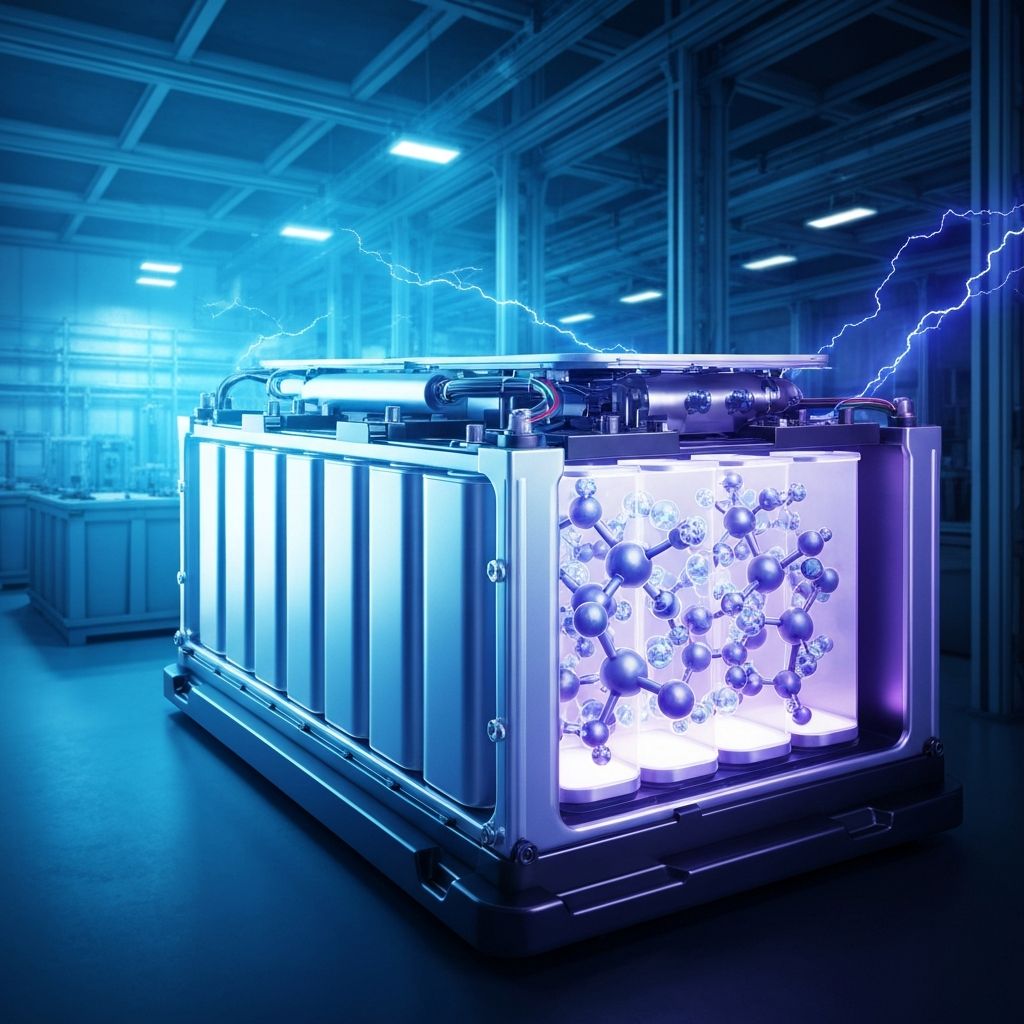
Quantum-Accelerated
EV Battery Electrolyte Design
Classical DFT fails at the electron correlation problem that governs solid-state electrolyte performance. Our VQE-powered quantum simulation platform solves this with chemical accuracy, screening 10-100x more candidates than classical methods.
Classical Simulation Cannot Solve the Electron Correlation Problem
The bottleneck to next-gen batteries is computational, not experimental.
The Solid-State Electrolyte Bottleneck
Today's lithium-ion batteries are approaching their theoretical energy density limits (~300 Wh/kg). Next-gen applications demand 500+ Wh/kg. Solid-state electrolytes are the critical enabler, but despite decades of research and billions invested, none has achieved commercial viability.
The bottleneck is computational. Classical DFT systematically misestimates activation barriers by 0.1-0.3 eV. Since conductivity depends exponentially on these barriers (Arrhenius), this translates to 10-100x errors in predicted performance.
The Exponential Wall
For 40 electrons in 80 orbitals, the wavefunction has 10^23 configurations. No classical computer can solve this exactly. But a quantum computer with 80 qubits can represent the full space natively.

Hybrid Quantum-Classical Materials Discovery Pipeline
Four-stage workflow from classical pre-screening to experimental validation.
VQE Quantum Simulation Engine
Variational Quantum Eigensolver with UCCSD ansatz computes electron correlation with chemical accuracy (<1 kcal/mol). Captures the many-body physics that DFT misses at interfaces, grain boundaries, and amorphous regions.
High-Throughput Screening Pipeline
4-stage hybrid workflow: Classical DFT pre-screening (10^6 candidates) → Quantum refinement (10^4) → ML interpolation (10^5 effective) → Experimental validation. 10-100x throughput vs. classical-only methods.
Error Mitigation Framework
Zero-Noise Extrapolation (ZNE), Probabilistic Error Cancellation (PEC), and symmetry verification extract accurate results from noisy NISQ hardware. Reference state calibration against known systems.
ML-Augmented Discovery
Graph neural networks and equivariant NNs trained on quantum simulation results create surrogate models that rapidly predict properties for compositional variations, expanding effective screening by 10x.

The $400B EV Revolution Needs Better Batteries

Quantum Advantage in the Canonical BQP Domain
vs. Classical DFT Screening (Schrodinger, VASP)
Classical methods systematically fail at electron correlation. Our quantum simulations capture interfacial physics with chemical accuracy, the property that determines real-world battery performance.
vs. QuantumScape / Solid Power
These are battery companies doing trial-and-error synthesis. We are the computational engine that accelerates discovery for the entire industry, platform, not product.
vs. IBM / Google Quantum Chemistry
Big tech focuses on general quantum chemistry demos. We're domain-specialized for battery electrolytes, with proprietary ansatz circuits and error mitigation tuned for materials science.
Canonical BQP Advantage
This is not speculative quantum advantage, simulating quantum systems IS the canonical use case for quantum computers. Provable exponential speedup over classical methods for electron correlation.

From Quantum Simulation to Commercial Electrolyte IP
Quantum Simulation Platform v1
VQE engine for Li-ion hopping sites (4-8 active electrons, 8-16 qubits). Error mitigation framework. First candidate ranking against experimental benchmarks. IBM/Google QPU partnerships.
Grain Boundary & Interface Simulations
Scale to 10-20 active electrons (20-40 qubits). Grain boundary resistance modeling. ML surrogate model training. First OEM partnership for joint electrolyte screening campaigns.
Full Interface Simulation & Validation
20-40 active electrons (40-80 qubits). Complete electrode-electrolyte interface modeling. Top 3 electrolyte candidates in experimental validation with manufacturing partners.
Commercialization & IP Licensing
First electrolyte composition licensed to battery manufacturer. Materials-as-a-Service platform launch. Expansion beyond solid-state to next-gen chemistries (sodium-ion, zinc-air).

From EV Batteries to Grid Storage to Aviation
Automotive Solid-State Batteries
Design solid electrolytes with >1 mS/cm conductivity, >5V stability window, and lithium metal anode compatibility. Enable 500+ Wh/kg energy density for 500+ mile range EVs.
Fast-Charging Electrolytes
Optimize ion transport pathways for uniform lithium deposition without dendrite formation. Enable 10-minute charging for consumer EVs and commercial fleet operations.
Grid-Scale Energy Storage
Design low-cost, ultra-long-cycle electrolytes for stationary storage. Sodium-ion and zinc-air chemistries for grid applications where cost/cycle matters more than energy density.
Electric Aviation
Ultra-high-energy-density electrolytes for electric aircraft. Wide temperature range operation (-40C to +80C). Safety-critical applications requiring zero thermal runaway risk.
Quantum Chemistry for Materials Discovery
Simulation Pipeline
Stage 1: Classical Pre-Screening
DFT (VASP/Quantum ESPRESSO) filters 10^6+ candidates on thermodynamic stability, band gap, approximate conductivity
Stage 2: VQE Quantum Refinement
UCCSD ansatz on IBM/Google QPUs, electron correlation at interfaces and grain boundaries, chemical accuracy verification
Stage 3: ML Interpolation
Graph neural networks (GNNs) and equivariant NNs trained on quantum data, 10x effective screening expansion
Stage 4: Experimental Validation
Top candidates synthesized by manufacturing partners, feedback loop to improve quantum models
Quantum Computing Stack
- VQE with UCCSD (Unitary Coupled Cluster Singles & Doubles)
- 4-80 qubit active space calculations
- Zero-Noise Extrapolation (ZNE) error mitigation
- Probabilistic Error Cancellation (PEC)
- Symmetry verification post-selection
- Reference state calibration
- IBM Eagle/Heron & Google Sycamore QPU access
- Qiskit & Cirq SDK integration
- 12-50 correlated electron simulation capability
- Sub-kcal/mol accuracy for activation barriers

Platform + IP Licensing with Recurring Computational Services
Materials-as-a-Service
Per electrolyte composition license to battery manufacturers. Royalty-based pricing tied to cell production volume. 95% gross margins on IP.
Computational Services
Annual quantum screening campaigns for OEM partners. Custom electrolyte optimization for specific cell designs and manufacturing processes.
Joint Development
Co-development agreements with battery manufacturers. Milestone-based payments with shared IP. Government R&D grants (DOE, ARPA-E, NSF).